Are you ancestral wellness curious and passionate about embracing a low-tox lifestyle? At Grass Fed Skin, we believe in whole body health that embraces real ingredients for natural skincare. That includes safe sun exposure and tallow sunscreen.
Below, we’re diving into how to enjoy a healthy balance of sun exposure for naturally created Vitamin D, what to stay away from in chemical sunscreen, and what to run towards when it comes to mineral sunscreen & beef tallow sunscreen. We’re going there, and we’re inviting you to come along for the ride!
Vitamin D, Sun Exposure, and Finding the Balance
We’re big fans of ancestral living, because of this, we know that connecting to nature through a daily dose of sunlight is the best way for our bodies to produce natural Vitamin D.
But what’s all the fuss about Vitamin D? Truthfully, it has a big impact on our bodies! Vitamin D supports the health of our bones and teeth, modulates our immune system’s responses, improves mood, reduces fatigue, promotes strength and recovery when it comes to muscle function, and provides support in battling chronic disease.
Needless to say, if Vitamin D had a cheering section, we’d be the first ones in line to shout about all of the amazing benefits it provides our bodies. However, enjoying the benefits of naturally produced vitamin D comes with the struggle of trying to find the right balance of practicing safe, daily sun exposure without sunscreen.
Why skip the sunscreen for daily exposure? Sunscreen is designed to do one thing: block UV rays in order to prevent sunburn and reduce the risk of skin cancer. While sunscreen is busy doing its job, battling UV rays, sunscreen is also blocking our bodies’ ability to naturally produce it’s own Vitamin D.
Believe it or not, exposure isn’t exactly the enemy in this situation. However, the amount of exposure we get can be.
If you plan on enjoying daily sun exposure without sunscreen to enhance your Vitamin D production, it should only be enjoyed in short bursts.
Your total time spent soaking up the sun without sunscreen will all depend on your skin type, along with where you live and the current season. For example, those with very fair skin can only spend about 5-10 minutes in the sun without sunscreen before UV rays are considered to be harmful. Meanwhile, those with skin type V (olive to dark brown skin) can spend up to 60 minutes in the sun without sunscreen [1].
As with most things in life, too much of a good thing can still be detrimental. While we love that our bodies have the ability to produce their own Vitamin D through sun exposure, we still have to protect our skin during longer periods of exposure.
Chemical Sunscreen vs Mineral Sunscreen
Once your body has earned its daily amount of Vitamin D production, it’s time to reach for the sunscreen. Supporting a low-tox lifestyle and embracing ancestral living means getting to know the ingredients in your sunscreen and becoming familiar with how they help or how they hurt.
When it comes to selecting sunscreen, doesn’t it seem like our options are endless? We’re sure you’re familiar with the scene. Rows and rows of brightly colored sunscreen bottles lining the shelves. They all promise ‘non-greasy, water protection, broad spectrum’ coverage up to SPF 15, 30, 50, or even 100.
We don’t know about you, but our first reaction when picking up a bottle of sunscreen is to flip it over to take a peek at the ingredients listed on the back. Those ingredient lists usually include lots of words we can’t even pronounce. That ingredient list might have you reaching for your phone to ask ChatGPT so that you can find out exactly what they are, and more importantly, what they do.
If you’ve ever experienced this scenario in real time, you might’ve come across the following ingredients:
- Oxybenzone – perhaps the worst culprit of all! Oxybenzone is bad for the environment and a known endocrine disruptor
- Octinoxate – mimics estrogen and can disrupt thyroid function [2]
- Octocrylene – Often contains benzophenone, which is a known carcinogen
- Parabens – accumulate on the skin and penetrate slowly over time; linked to hormone disruption [3]
So why are these chemical ingredients being used in sunscreen if they are so bad for our bodies? The simple answer is this: they block UV rays. But our ancestors knew there was a better way, all along.
Whole Body Health with Natural Skincare
There’s no denying that the need for sunscreen during prolonged sun exposure is necessary. What we’re saying is, you have options for nourishing and protecting your skin, beyond chemical sunscreens.
It’s time to introduce you to the low-tox counterpart, mineral sunscreen! Mineral sunscreen contains just that, minerals; naturally occurring inorganic substances. If the word inorganic freaks you out a bit, don’t worry, it just means that a carbon-hydrogen bond is absent.
With mineral sunscreen, the primary ingredients are typically zinc oxide or titanium dioxide. We recommend sticking with zinc oxide, and more specifically, non-nano zinc oxide. Here’s why:
Certain types of Titanium Dioxide have been studied and shown to cause oxidative damage to cells that could be linked to inflammation, immune response and even cancer [5]. While more research is needed, we like to play it safe and stick with zinc oxide (this is what you’ll see marketed in sunscreen for babies).
Where chemical sunscreens will allow UV rays to pass the skin barrier and chemically “dissolve” the harmful UV, mineral sunscreen with Zinc Oxide acts as a physical barrier and reflects the sun rays off the skin so it bounces off instead of being absorbed.
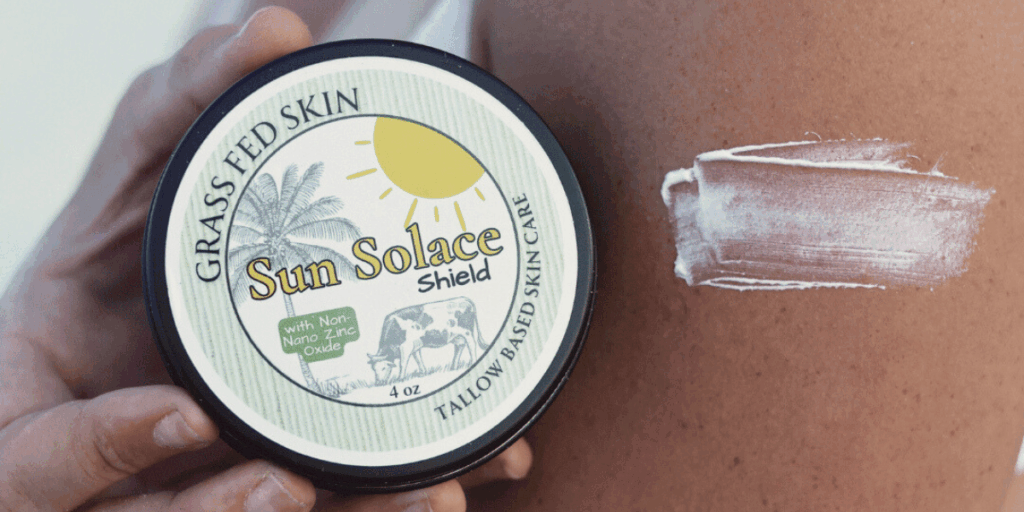
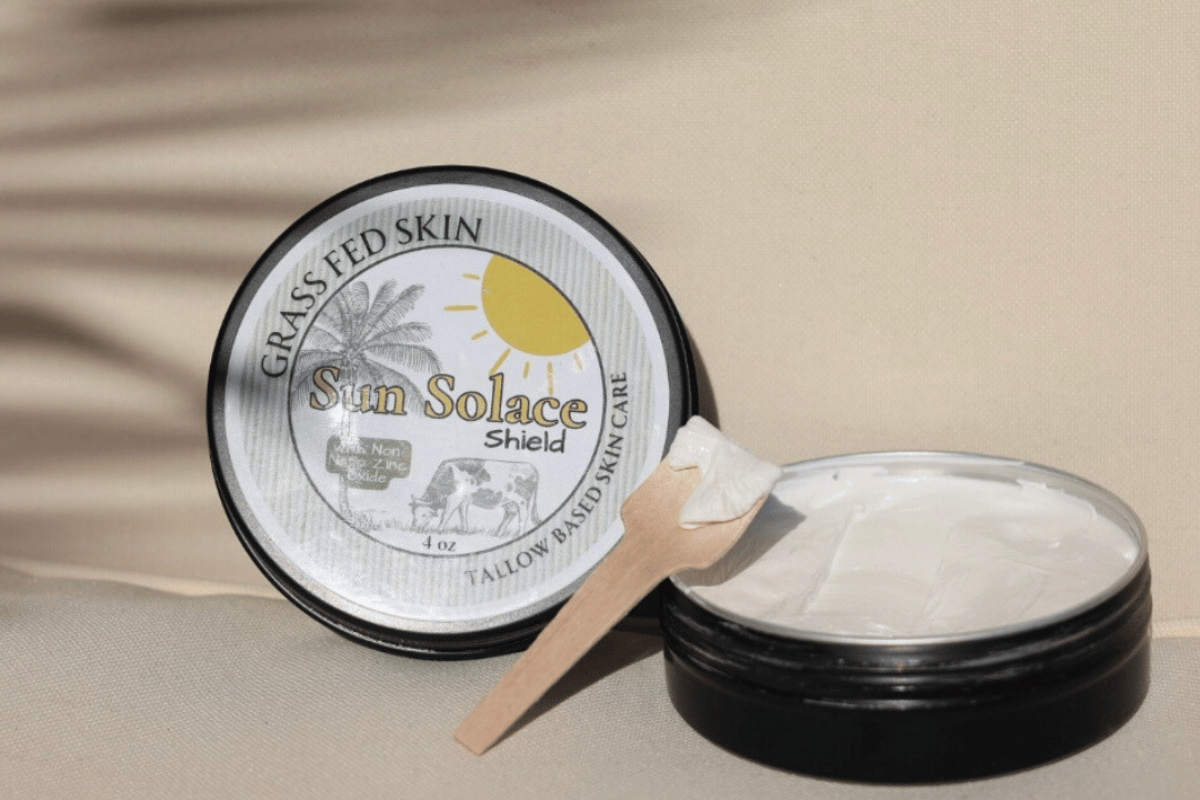
Where our Sun Solace Shield really shines is it uses non-nano zinc. This refers to the size of the molecules, so non-nano are larger molecules that are too large to enter the bloodstream, tissues or organs. This is important because even though it’s a natural mineral; you don’t want too much of that getting absorbed into the body and posing the risk of hormone disruption and other health concerns. The use of non-nano zinc is also better for the environment, so you can feel good about sunscreen with non-nano zinc when you’re enjoying a day at the beach [4].
Tallow Sunscreen is the Nourishing Option
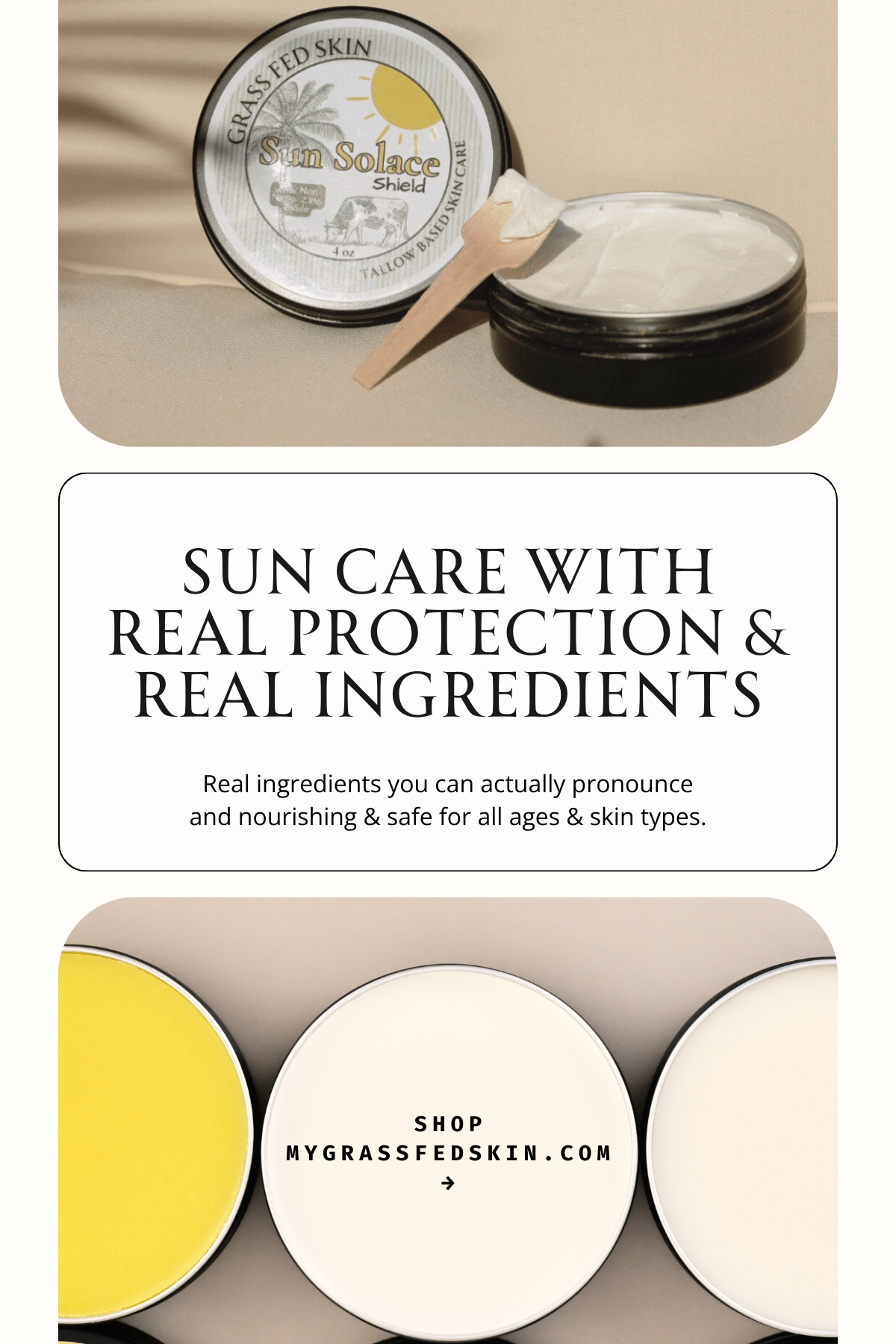
There just so happens to be one other valuable player hiding out in our Sun Solace Shield, and that’s farm-to-skin beef tallow. Tallow sunscreen embraces ancestral wellness by adding an easily recognizable ingredient to your sunscreen to work with your body and the environment, not against it.
Our tallow sunscreen is rendered from grass-fed cows and contains fat-soluble vitamins such as A, D, E, and K. It’s incredibly smooth and moisturizing. But where it really has the biggest impact is when it joins forces with non-nano zinc oxide.
Tallow sunscreen with non-nano zinc nourishes the skin while creating a barrier that protects you and the whole family from harmful UV rays. You get a safe way to enjoy the sun, all without disrupting your hormones, harming the environment, or sending your endocrine system into shock.
Benefits of Beef Tallow Sunscreen
Our beef tallow sunscreen contains none of those toxic chemical ingredients you were furiously Googling in the store before you put the bottle of sunscreen back on the shelf. Bye-bye confusing labels!
Instead, our nourishing beef tallow sunscreen provides all these benefits:
- UV protection when combined with non-nano zinc oxide
- Natural ingredients
- Non-toxic
- Reef safe
- Nourishes & moisturizes the skin
- Supports ancestral wellness
- Safe for the whole family – yes, even those sweet babies of yours!
Choosing the Right Tallow-Based Sunscreen For Your Family
Did you know, with most tallow-based sunscreens, tallow is listed near the end of the ingredient list? If you’re still keeping up with flipping over bottles and reading labels, you’ll know that ingredients are listed in order of concentration. So if tallow is at the bottom of the list, then it’s because there is only a small trace amount added to the product.
The Grass Fed Skin Difference: In many of our products, including our line of Sun Solace, tallow is the first or second ingredient. In addition to that, all of our products are preservative-free, except for the Sun Solace Cooling Afterglow, which is crafted with an all-natural fermented preservative.
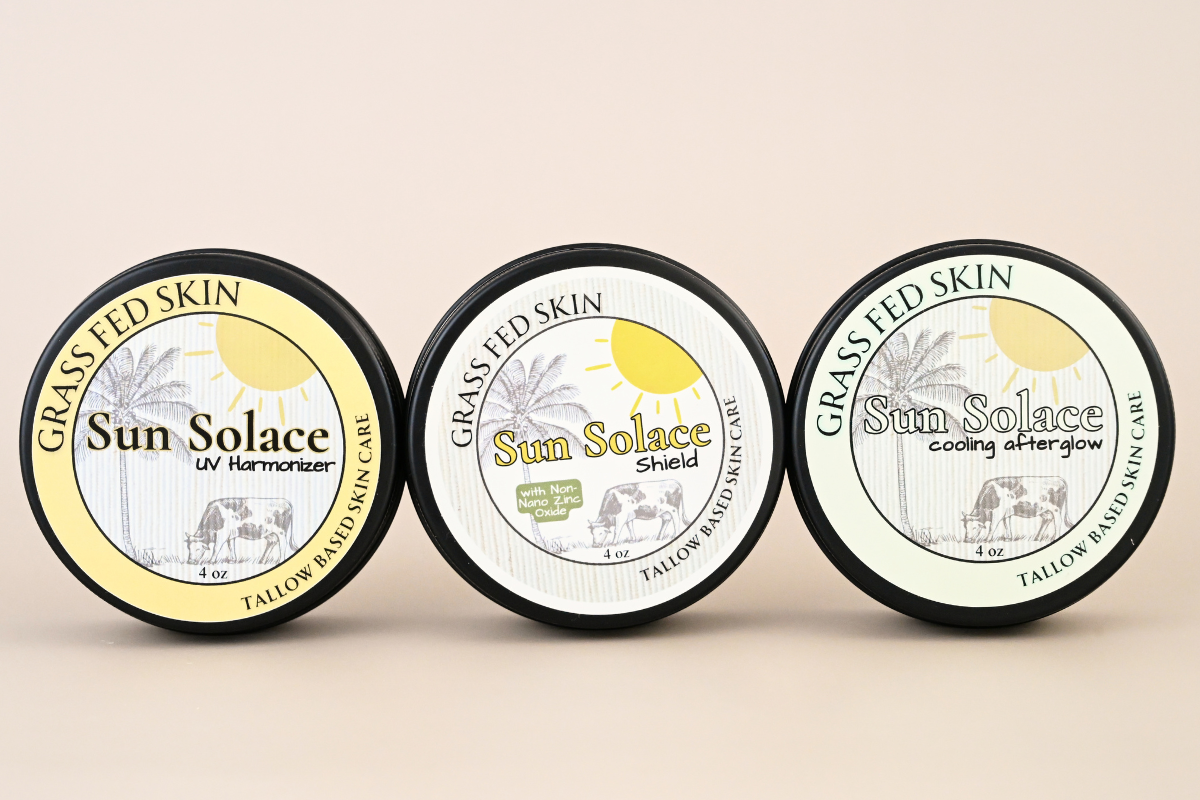
Wondering which tallow-based sunscreen will be best for the whole family? We’re breaking down the specifics on each of our Sun Solace products for you below.
- Contains non-nano zinc oxide
- SPF 40 sunscreen
- Perfect if you burn easily or spend time in the sun during 10 am – 2pm
- Contains: grass-fed beef tallow, organic beeswax, mango butter, and cold-pressed coconut oil
- Best for: a day at the beach, by the pool, or on the boat!
- Natural sunscreen alternative
- Provide anywhere from 28-50 SPF equivalent
- Anti-aging benefits from red raspberry seed
- Moisturizes
- Stays on skin underwater
- Contains: beef tallow, red raspberry seed
- Ideal for light-to-moderate sun exposure, great for a glow without the burn
- Creamy texture for smooth and easy application
- Contains: aloe vera, cucumber oil, and raw local honey
- Perfect for cooling and soothing sunburned skin
Good Sun Exposure Doesn’t Have to Be Toxic
The moral of the story? Sun care and safe sun exposure can be enjoyed in a way that doesn’t include chemicals and supports a low-tox lifestyle. You can enjoy the sun in moderate amounts each day to create natural Vitamin D before applying tallow sunscreen to protect your skin from harmful UV rays. Sunscreen with minimalist ingredients and maximum results does exist, so you can set down that bottle and apply tallow sunscreen with peace of mind for you and the whole family.
TL: DR
Is sun exposure good for you?
Yes! Sun exposure, without sunscreen, can be enjoyed in short bursts (depending on your skin tone and location) for natural Vitamin D production.
Does tallow sunscreen actually work?
When tallow sunscreen is paired with minerals like non-nano zinc, it not only works to protect you from the sun but also offers a nourishing effect to your skin and is safe for the environment.
What sunscreen promotes clean skincare?
Ditch the chemical ingredients in sunscreen like oxybenzone, octocrylene, and parabens, and choose a tallow sunscreen with minerals like non-nano zinc, zinc oxide, and titanium dioxide.
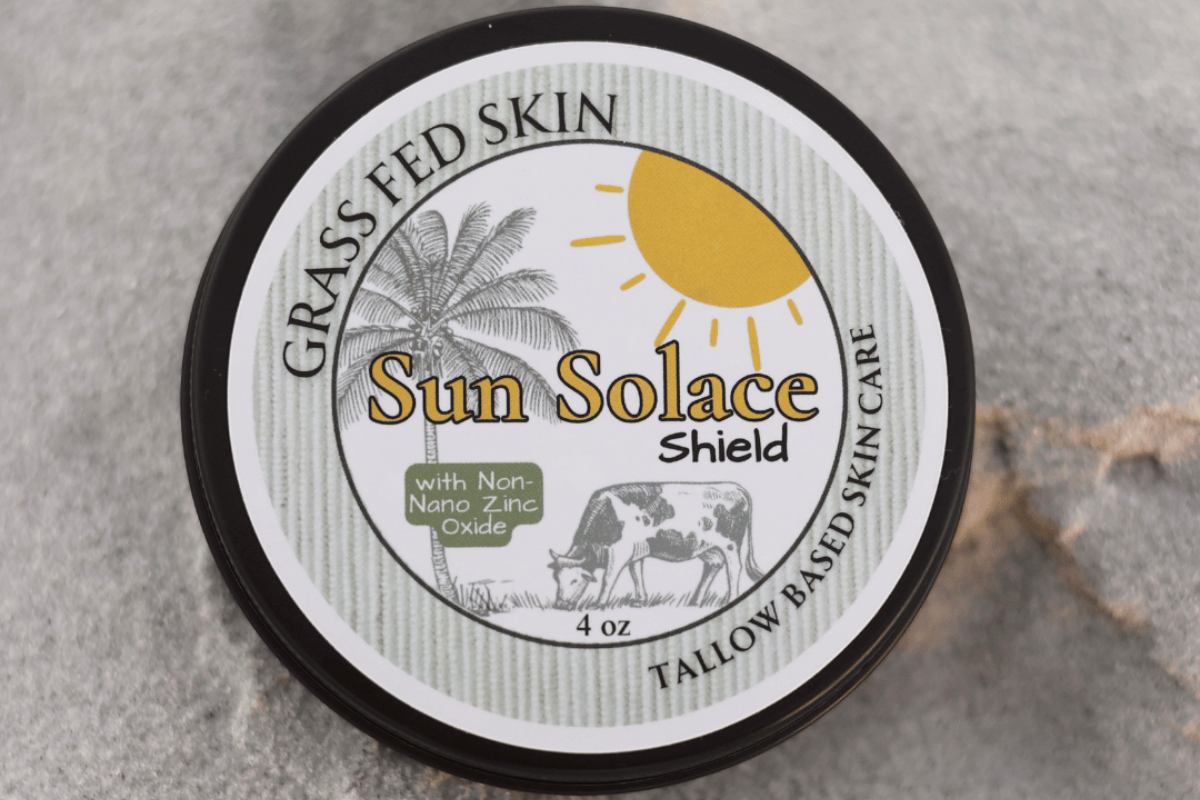
Still here? If you want to go from tallow sunscreen curious to tallow sunscreen devotee, a good place to start is with Sun Solace Shield, which is designed for coverage during peak UV hours when protection is needed the most.
References
- InformedHealth.org [Internet]. Cologne, Germany: Institute for Quality and Efficiency in Health Care (IQWiG); 2006-. In brief: How much sun is too much? [Updated 2022 Jul 4]. Available from: https://www.ncbi.nlm.nih.gov/books/NBK321117/
- Onyango DO, Selman BG, Rose JL, Ellison CA, Nash JF. Comparison between endocrine activity assessed using ToxCast/Tox21 database and human plasma concentration of sunscreen active ingredients/UV filters. Toxicol Sci. 2023 Oct 30;196(1):25-37. doi: 10.1093/toxsci/kfad082. PMID: 37561120; PMCID: PMC10613966.https://pmc.ncbi.nlm.nih.gov/articles/PMC10613966/
- Wang L, Liu X, Zhao M, Li F, Liu J. Disruption of gonadotropin hormone biosynthesis by parabens: A potential development and reproduction-associated adverse outcome pathway. Environ Pollut. 2024 Apr 15;347:123716. doi: 10.1016/j.envpol.2024.123716. Epub 2024 Mar 6. PMID: 38458526. https://pubmed.ncbi.nlm.nih.gov/38458526/
- Nanoparticles in Sunscreens. Environmental Working Group. 2023 May 23. https://www.ewg.org/sunscreen/nanoparticles-in-sunscreen/
- Skocaj, M., Filipic, M., Petkovic, J., & Novak, S. (2011). Titanium dioxide in our everyday life; is it safe?. Radiology and oncology, 45(4), 227–247. https://pmc.ncbi.nlm.nih.gov/articles/PMC3423755/
DISCLAIMER: THIS WEBSITE DOES NOT PROVIDE MEDICAL ADVICE
The content on this website is for informational or educational purposes only and does not substitute professional medical advice or consultations with healthcare professionals. Always seek the advice of your physician or other qualified healthcare provider(s) with any questions you have regarding a medical condition or treatment and before undertaking a new health care regimen.